Researchers test whether machine learning can help LIBS classify real plastic waste when laser conditions vary.
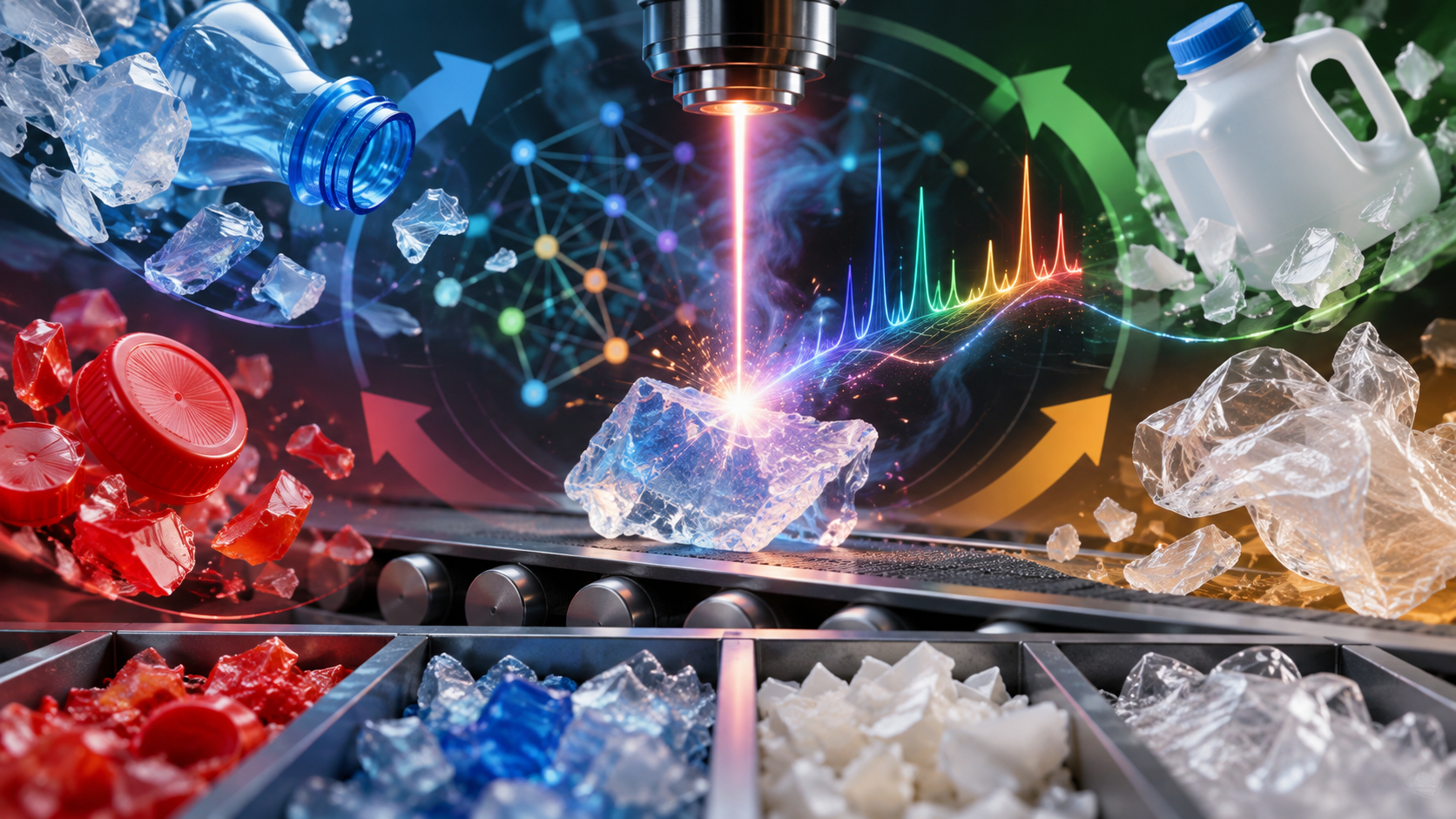
Paper: Classification of real plastic waste using machine learning-assisted laser-induced breakdown spectroscopy. AI-generated abstract conceptual image created using ChatGPT/OpenAi
A recent study in Scientific Reports explores the use of machine learning-assisted laser-induced breakdown spectroscopy to classify real plastic waste. The researchers investigate four common polymers using three laser pulse energies to approximate changes in laser irradiance that can occur when sample height, surface topology, focusing, or system operation varies.
The findings suggest that combining spectroscopic analysis with machine learning could improve the reliability of plastic waste sorting under changing measurement conditions.
Tackling variability in real plastic classification
Laser-induced breakdown spectroscopy (LIBS) offers a rapid approach that requires no separate chemical preparation for identifying plastic materials. A laser pulse generates a plasma from the sample, and the resulting emission provides elemental and molecular information about its composition. Variations in sample height, surface shape, color, reflectivity, and laser focusing can alter the plasma response and introduce spectral variability.
Previous LIBS studies have demonstrated strong plastic-classification performance under controlled laboratory conditions. Those conditions may not fully represent waste-sorting environments, where plastic pieces often have uneven surfaces, different optical properties, and varying positions relative to the laser.
Some earlier studies split the data at the spectrum level, allowing spectra from the same object to be included in both model development and evaluation. That does not test a new waste object.
The study examines whether machine learning-assisted LIBS can distinguish common plastic types under variations in laser irradiance and sample characteristics. The researchers used three laser pulse energies to introduce controlled changes in laser irradiance, trained the models on standard plastic specimens, and evaluated their performance on physically separate real-world waste specimens. The experiment remained controlled rather than reproducing a complete industrial conveyor line.
Experimental setup and classification strategy
The team selected polypropylene (PP), polyethylene terephthalate (PET), high-density polyethylene (HDPE), and low-density polyethylene (LDPE) because these polymers constitute significant fractions of plastic waste.
For each polymer, they prepared one standard specimen without additives and one physically separate real-waste specimen. The waste specimens were relatively clean used products, not landfill or mixed municipal waste. They removed external labels and visible adhesive residues from the measurement areas. The study did not independently characterize intrinsic additives such as pigments, fillers, and stabilizers.
The team cut the specimens into 50 × 50 mm pieces and mounted them on a rotary table. The table moved the samples between laser shots so that consecutive pulses did not strike the same location repeatedly. The LIBS system used a Q-switched Nd:YAG laser operating at 1064 nm with a 6 ns pulse duration. An optical fiber collected the plasma emission, while a spectrometer recorded wavelengths from 200 to 1100 nm with a resolution of 2.3 nm.
The team used laser pulse energies of 29.6, 37.3, and 42.2 mJ. These values were chosen to approximate laser-irradiance fluctuations associated with changes in focal conditions.
Across the four polymer classes, the researchers collected 28,800 single-shot spectra. They tested averaging, smoothing, baseline subtraction, and normalization to improve spectral quality. They then applied seven variable-selection strategies to identify informative wavelengths.
PCA reduced the dimensionality of the selected data, while kNN performed the final classification. They trained and tuned the models using only standard-material data. They kept the real-waste spectra separate and applied the resulting analytical pipelines without refitting them. The waste set was still used to compare predefined pipelines, so the authors treat the result as exploratory rather than independent external validation.
Spectral variations reveal the need for data processing
The LIBS measurements produced characteristic emissions from carbon, hydrogen, oxygen, and nitrogen, together with molecular bands from C2, N2, and CN. The spectra changed noticeably with laser energy and specimen type. Higher laser energy generally increased emission intensity, but each polymer responded differently.
Real-waste samples also showed larger intensity changes than standard materials in several cases. These differences show how sample properties can influence LIBS signals under variable measurement conditions.
The analysis showed that H/C and C2/C1 ratios varied with sample color and surface reflectivity, while reactions with ambient air also altered several spectral signals. Oxygen and nitrogen signals also appeared in the PE and PP spectra, even though the basic structures of PE and PP do not contain oxygen or nitrogen.
The initial test accuracy reached only 0.617. The model confused PET with LDPE and incorrectly classified 72 HDPE spectra as PET. These errors indicate that spectral variability under the deliberately varied conditions can overwhelm the chemical differences needed for reliable classification.
Averaging multiple spectra reduced shot-to-shot fluctuations and improved the separation of polymer groups in PCA space. But averaging did not consistently deliver high classification accuracy. Smoothing, baseline subtraction, and normalization also yielded limited gains when used without variable selection.
Combining preprocessing with wavelength selection produced the largest improvement. Different selection methods identified different spectral regions as useful for separating the polymers. Several methods pointed to regions associated with hydrogen, carbon, nitrogen, CN, and C2 emissions.
The best analytical pipeline achieved 1.00 accuracy on the held-out spectra from four physically separate real-waste specimens, with one specimen representing each polymer class. The authors treated multiple spectra from the same specimen as repeated measurements rather than separate waste objects.
The result shows successful classification of those specific held-out specimens; it does not establish performance across the wider range of post-consumer plastic waste.
Toward practical plastic sorting under variable conditions
The study shows how data processing can help LIBS classify plastics under varying measurement conditions. By deliberately varying laser energy, the researchers examined how changes in spectral response affect classification and how models trained on standard materials perform when applied to separate real-waste specimens. This gives a controlled test of model transfer beyond a single fixed laboratory condition.
Averaging multiple laser shots reduced spectral fluctuations and improved data quality, but it could not fully resolve differences between standard plastics and real waste.
Combining preprocessing with variable selection produced greater improvements by reducing irrelevant or distorted spectral information while retaining informative features. The gains depended on pairing preprocessing with a suitable variable-selection method; some combinations performed worse.
Standard materials may provide a useful basis for classification models and reduce reliance on large real-waste datasets. That finding remains preliminary because the study evaluated only one real-waste specimen per polymer class.
Future studies should evaluate larger and more diverse waste datasets, including irregular and moving samples. Training with multiple laser-irradiation conditions and developing broader LIBS databases could improve tolerance to laser-sample variability. The method could support more adaptable automated plastic sorting, but larger-scale specimen-level validation is needed before its industrial performance can be assessed.
Disclaimer: The views expressed here are those of the author expressed in their private capacity and do not necessarily represent the views of AZoM.com Limited T/A AZoNetwork the owner and operator of this website. This disclaimer forms part of the Terms and conditions of use of this website.