Lunar regolith is a strategic resource in space science and technology. To date, the Chang’e lunar probes have successfully returned lunar regolith samples on two occasions, totaling just 3.6 kg. As the nation actively advances the utilization of lunar resources, including the use of lunar regolith for manufacturing construction materials and components, a team led by Professor Li Yangyang from the Department of Materials Science and Engineering at City University of Hong Kong (CityUHK) is developing a high-fidelity lunar regolith simulant.
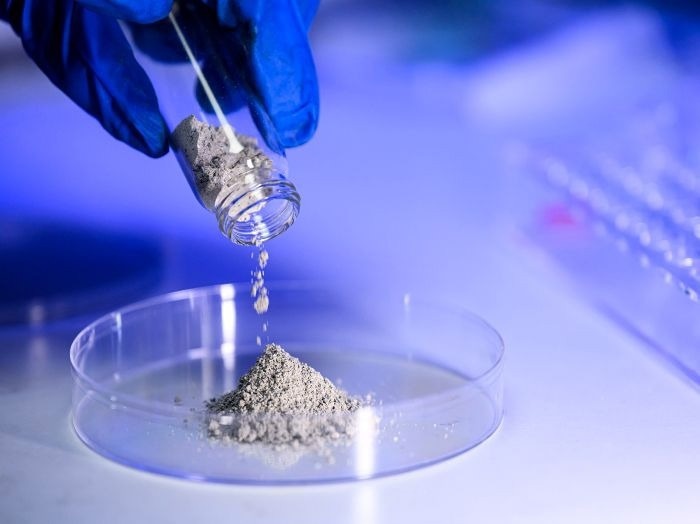 The team has produced a first-generation 3D-printable lunar regolith simulant. Image Credit: City University of Hong Kong
The research aims to deepen understanding of the material’s thermal properties and chemical reactivity, providing scientific support for the national lunar missions.
Most relevant engineering applications and scientific research rely on lunar regolith simulants, which are typically produced using natural minerals sourced on Earth. However, these minerals often contain impurities and require extensive processing.
Professor Li noted, “As the Earth and the Moon have different environmental conditions, the same mineral formed under these conditions can display different microstructures and material properties. Research based on traditional lunar regolith simulants may lead to deviations and misjudgments, potentially resulting in major losses in space missions.”
Lunar rovers are among the spacecraft that rely on lunar regolith simulants for design validation and performance optimization. The loose lunar regolith can reduce traction, while the fine, abrasive lunar dust can easily clog the mechanical structure of lunar rovers, causing damage. Lunar dust can also accumulate on solar panels, significantly reducing their power-generation efficiency. The more accurately a simulant replicates the properties of actual lunar regolith, the more effectively researchers can improve rover designs.
Supported by funding from the Innovation and Technology Commission (ITC)’s Innovation and Technology Support Programme Special Call on Aerospace Technology since April 2025, Professor Li’s team has been engaged in a three-year research project. To accurately replicate the properties of real lunar regolith, the team has adopted a hydrolysis method to synthesize lunar regolith simulant, enabling precise control over its chemical composition, mineral proportions, crystal structure and particle characteristics.
For this project, the CityUHK team has collaborated closely with the Qian Xuesen Laboratory of Space Technology under the China Academy of Space Technology (CAST). Leveraging CityUHK’s strengths in materials science, Professor Li’s team is responsible for developing the lunar regolith simulant, while the CAST contributes its advanced mechanical design and experimental capacities to conduct 3D-printing and simulation tests.
Drawing on the elemental composition and structural characteristics of the lunar regolith samples collected by Chang’e-5, the team has developed synthesis protocols for four key lunar minerals. Through precise control of reaction conditions and thermal processing parameters, they have successfully fabricated the four target minerals and amorphous matter in lunar regolith, thus produced a first-generation 3D-printable lunar regolith simulant. Future studies will focus on evaluating its mechanical and thermal properties to assess its suitability for lunar infrastructure development and other extraterrestrial applications.
Professor Lu Jian, Chair Professor in the Department of Mechanical Engineering at CityUHK and a co-investigator of the project, noted, “The high-fidelity lunar regolith simulant is strategically important for national lunar missions and future deep-space exploration. It helps unlock the use of extraterrestrial resources while minimizing experimental risks. In addition, given the similarities in mineral compositions among celestial bodies, the successful development of lunar regolith simulants offers a valuable reference for the study of other extraterrestrial environments, facilitating future exploration initiatives, such as missions to Mars.”
The project also offers young researchers a unique opportunity to participate in major national scientific and technological initiatives, demonstrating CityUHK’s commitment to cultivating emerging research talent. Professor Li Hongkun, in the Department of Materials Science and Engineering, joined CityUHK as a Research Assistant Professor after completing his PhD under the supervision of Professor Lu and Professor Li. His research focuses on mineral synthesis, biomineralization and advanced materials engineering. Through his work on developing the high-fidelity lunar regolith simulant, he has had the opportunity to translate his expertise in materials science into practical applications for space exploration, contributing to the nation’s efforts in lunar exploration and advancing research on the utilization of extraterrestrial resources.
Professor Li noted, with the funding and support of the ITC, the team has achieved significant milestones in frontier research and talent cultivation. Looking ahead, it will further advance its technical research, foster innovation and industrial applications in aerospace technologies, deepen frontier research in deep space exploration, and contribute to the development of national space endeavors.